The “English Only” Movement
By 1986, Monterey Park’s demographic had changed drastically, compared to the city’s majority-white population in 1960. The Asian population was growing as Asian businesses emerged and marketed products specifically for their community. Products were sold and advertised in Chinese.
The “old-timers,” as Lily calls older Monterey Park residents, remembered the city before this population and culture shift and considered the change an “Asian invasion.” They felt their city was being “taken over by foreigners.”
An image that symbolized the racial tensions at the time was a sign hanging outside a vacant 76 service station saying, “Will the last American to leave Monterey Park please bring the flag?”

Lily angrily wrote a letter to the former owner of the gas station accusing him of libel and racism. When the news returned that the former owner hadn’t hung the sign himself, the implications were even worse. He responded by suing Lily and the city of Monterey Park, entangling them in a 2-million-dollar libel suit.
The “English Only” movement grew from here. Led by Frank Arcuri, Barry Hutch, and other old-timers of Monterey Park, the movement protested the “invasion of mini-malls, condos, and Asians.” These included efforts to have English as the official language of the city and restricting signs to only be in English language.
Many business owners who set up shops and printed signs without English saw little point in creating English language signs. As said by Jerry Chin-Chun Ha before the Monterey Park City Council and translated by Lily, Hua had posted only a Chinese sign because he felt his English was not proficient.
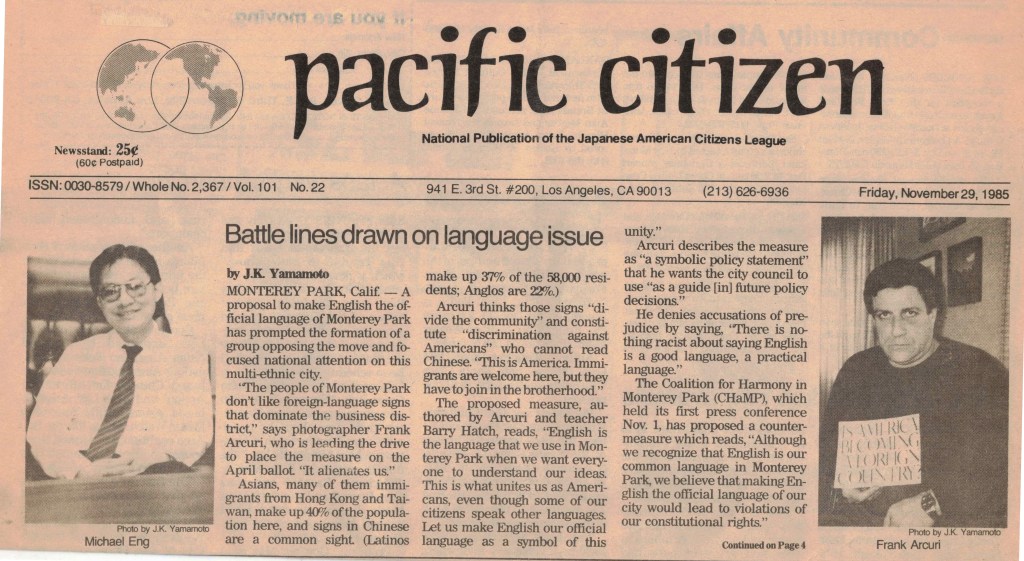
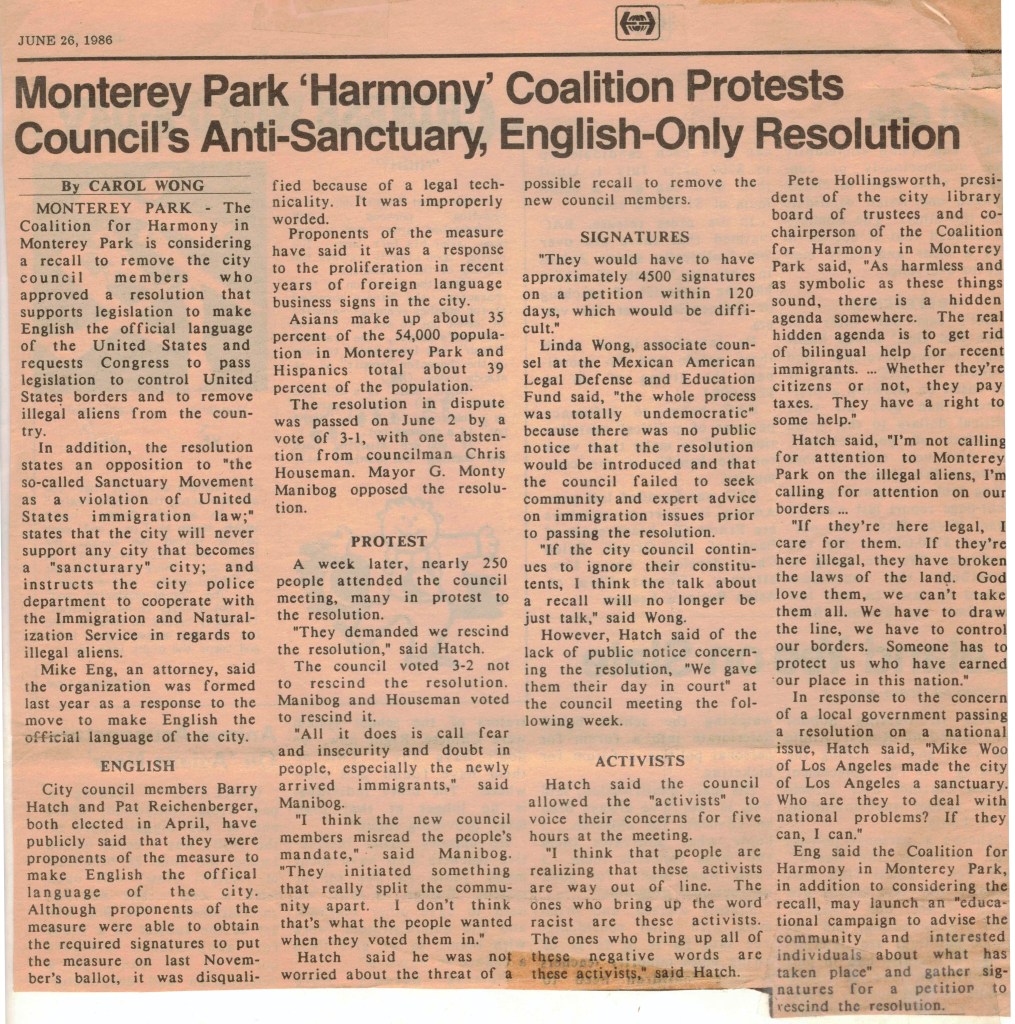

Lily felt the only way forward would be a compromise; she promoted “English Plus,” the idea of bilingual advertisements. She worked hard to encourage Chinese business owners to also write their signs in English.
In November 1986, Proposition 63 made English the official language of California when it passed with an overwhelming 3:1 ratio, a response to the demographics changing too quickly. The proposition itself also required legislature to use the appropriate legislation to enforce English as the official language, preserve and enhance English, and allows any person doing business to sue the state to enforce such provisions.
Mayoral Highlights
When Los Angeles hosted the 1984 Summer Olympics, Lily advocated for Monterey Park to host the field hockey games at East LA City College. Lily also convinced the president of East LA City College, Dr. Art Avila, to host the games at the stadium, and the Coca-Cola Company to sponsor both the renovations and the games themselves.
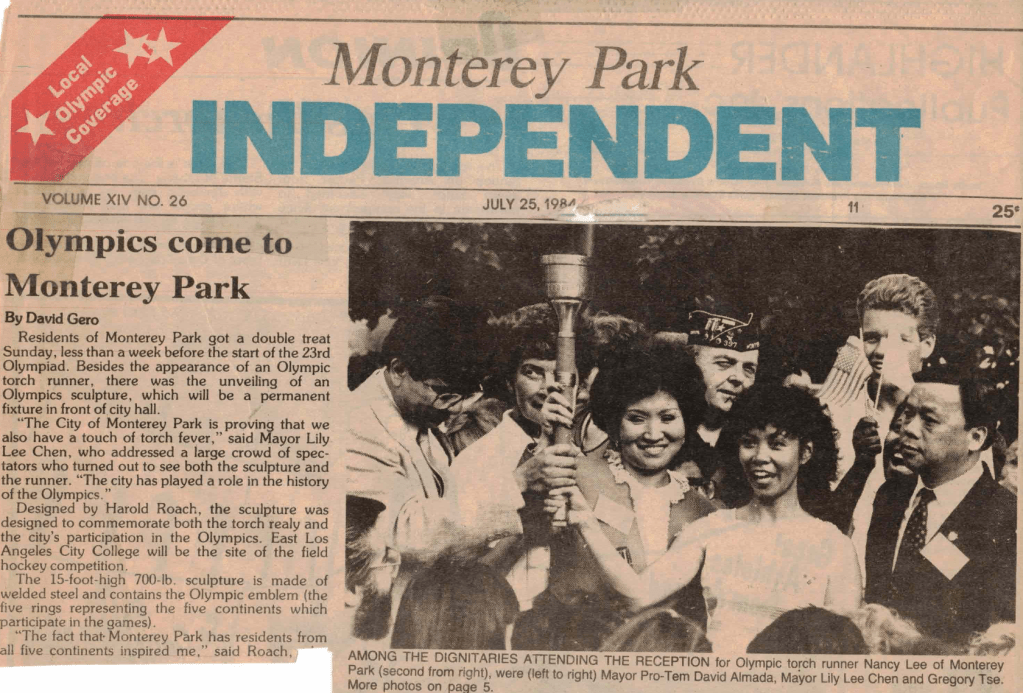
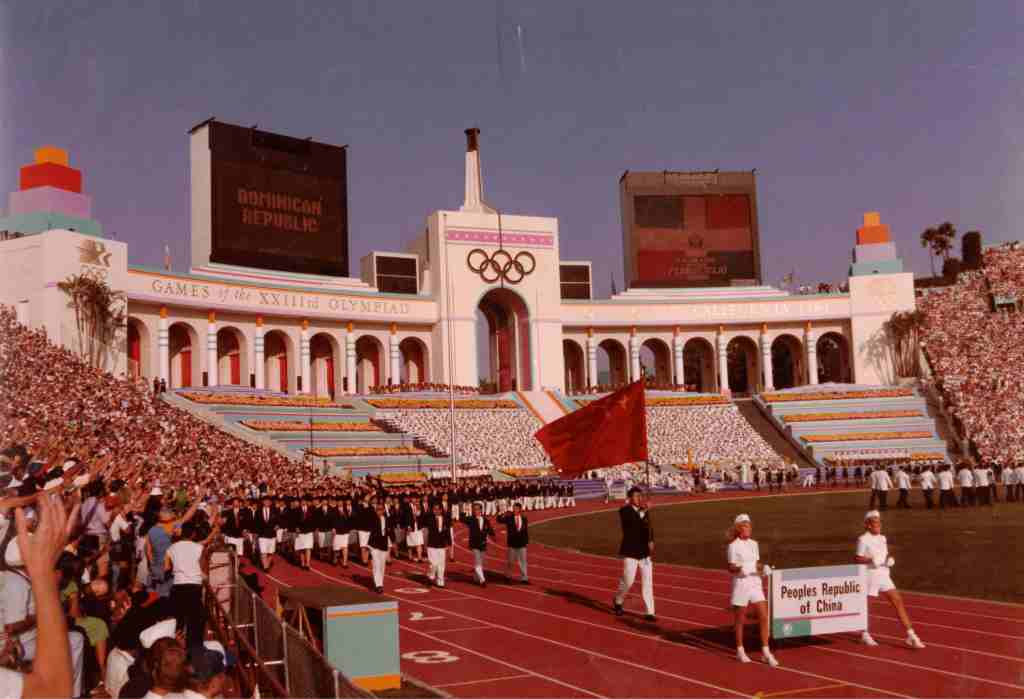

The 1984 Summer Olympics had another special meaning for Lily: it was the first year that China was able to participate in the Summer Olympics. Everyone cheered for the Chinese athletes. Lily hosted a grand celebration dinner in Monterey Park when Li Ning received a gold medal.

Lily applied to the National Civic League’s “All-America City Award” on behalf of Monterey Park. It was chosen as one of the eight All-America Cities in 1985 because its “ethnic mix [was] a success.”
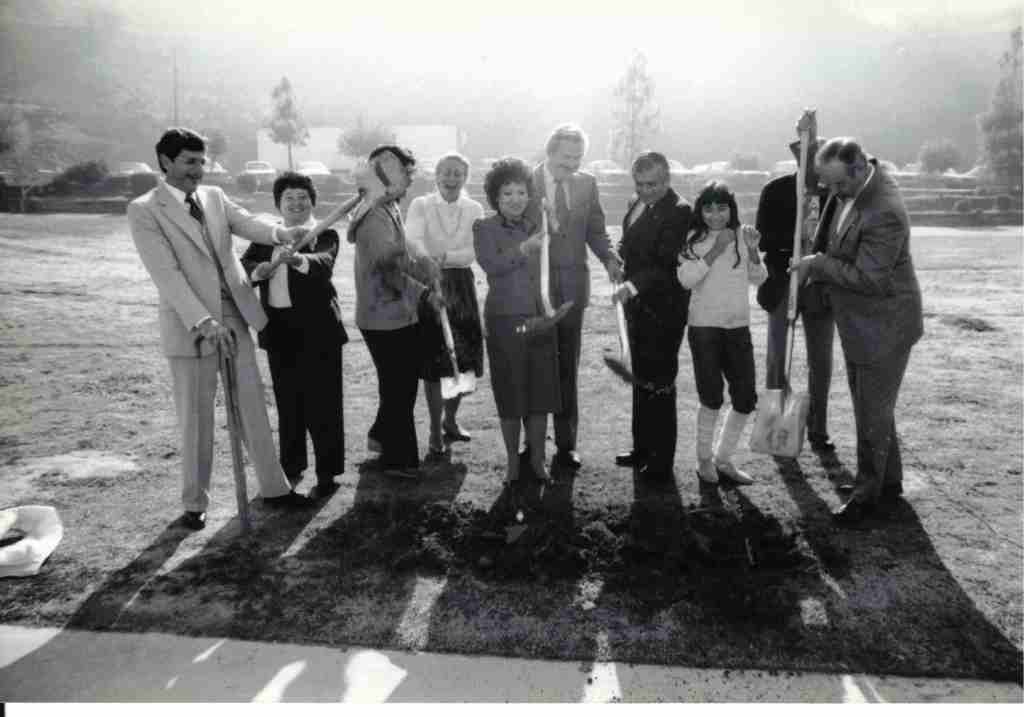
Lily oversaw the final stages of the Monterey Park Highlands Elementary School auditorium and cafeteria projects during her term—projects that had started long before she was in City Council. Lily applied for state and federal funding to finish these projects. She and the City Council pushed the Alhambra School District to provide the funds needed to build the auditorium. They received a 1.7-million-dollar state grant to build the auditorium and the cafeteria.
 Lily Lee Chen